- Whatsapp: +85270404389
- Email: [email protected]


Whether it’s a physical store selling bedding or a brand producing travel accessories, when making large – scale purchases, most companies often overlook the crucial indicator of foam density. But actually, this density directly affects customers’ satisfaction with the product and their willingness to buy it again. A lot of cheap and ordinary neck pillows on the market will collapse and deform within a few weeks and can’t support the cervical spine. People who sit at a desk for long hours, frequent flyers, or those with chronic neck pain will find these pillows totally useless for relief.
On the other hand, memory foam neck pillows with the right density ratio feel soft and can maintain support for a long time. These products are mainly divided into two types: one is for home sleep, and the other is for travel.
The needs of these two groups of people are very different. For those who use it at home for sleep, they need a pillow that can firmly support the neck all night to relieve the burden on the cervical spine caused by long – term head – lowering. For frequent travelers, they care more about the pillow’s lightness and ease of storage, and also need it to provide comfortable neck support. This guide summarizes the general foam density production standards of well – known memory foam neck pillow manufacturers, explains how the density level affects the user experience, compares the structural differences between home and travel styles, and shares how to maintain long – term cooperation with reliable suppliers. Also, the guide will help you choose according to specific scenarios, like how to pick a soft memory foam neck pillow for people with frequent neck pain and how to choose a portable memory foam travel neck pillow for long – haul flights.
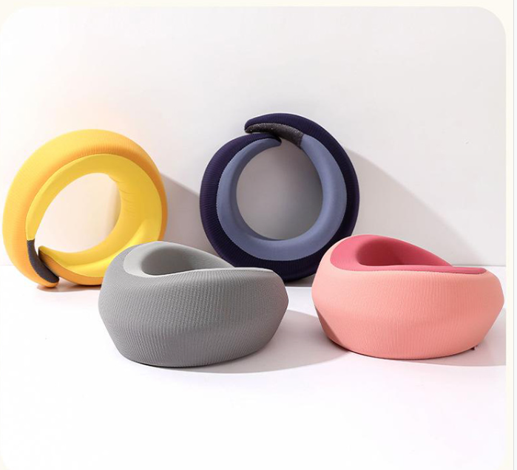
The unit of measurement for foam density is PCF (pounds per cubic foot). All memory foam neck pillows produced must use this value as a standard. Reliable manufacturers will set two sets of production requirements separately, one for home sleep pillows and the other for portable travel pillows. After all, the daily usage time and the degree of compression these two types of pillows endure are completely different.
When sleeping at home, the head and neck are in continuous contact with the neck pillow for 6 to 8 hours. So, the foam density of sleep – type memory foam neck pillows needs to be within a specific range to meet this need. The industry usually divides them into three grades, suitable for different groups of people. Each grade has different softness, hardness, and service life.
| Density Grade (PCF) | Surface Texture | Core Application | Expected Lifespan |
| 2.8–3.2 (Soft) | Plush, gentle sink-in feel | Lightweight users, mild cervical soreness | 2–3 years |
| 3.3–4.0 (Medium) | Balanced contouring support | Average adults, daily tech neck relief | 4–5 years |
| 4.1–5.0 (Firm High-Density) | Rigid long-lasting hold | Heavy frames, chronic cervical strain | 6–8 years |
The travel neck pillows you carry around are usually light, but you gotta fold and compress them a lot when packing. So, memory foam neck pillows travel have special requirements for foam density. Right now, the inner foam density of U-shaped travel neck pillows on the market is generally kept between 2.5–3.5 PCF, and there are two grades:
2.5–2.9 PCF: Super-light filling type. It’s mainly used for affordable travel accessories. You can compress it a lot and it’ll shrink, so you can easily stuff it into your checked luggage or suitcase without taking up much space.
3.0–3.5 PCF: High-quality foam for travel. Even if you fold it hundreds of times, it’ll slowly bounce back to its original shape when you let it go.
Most products labeled as “travel memory foam neck pillows” on the market use the high-quality 3.0–3.5 PCF foam to stop the pillow from getting squished into a ball, losing its shape, or collapsing and not being able to support your neck.
Foam density doesn’t just decide how soft the pillow is. It also directly affects whether it can keep fitting your neck after long-term use. Different densities give totally different experiences: one is about relieving neck pain, and the other is about the slow rebound performance of a travel pillow.
If your neck muscles are often stiff and painful, high-density hard foam will actually make you feel worse when sleeping. The 2.8–3.2 PCF soft foam can gradually spread the pressure on your neck without creating hard spots that irritate the muscles, so it won’t make the pain and inflammation worse.
If you wanna choose a soft memory foam neck pillow for people with neck problems, go for this density range first. And it’s better to choose one with a wave-shaped design. That way, it can support the hollow part under your neck naturally without forcing your neck into an unnatural position.
If you buy a foam pillow with a density lower than 2.5 PCF, it’ll collapse quickly and won’t give you good support. You’ll wake up with an even more painful neck. This is also the most common customer complaint that retailers give to suppliers every year.
The rebound speed of the foam depends directly on its density. This is the key difference when comparing memory foam slow-rebound neck pillows and inflatable travel pillows.
High-density travel foam (3.0–3.5 PCF) takes about 3–6 seconds to rebound. When there’s turbulence during a flight or when you’re sitting for a long time, it can effectively stabilize and cushion the vibrations, keeping your head relaxed.
Light foam (2.5–2.9 PCF) rebounds faster, about 1–2 seconds. It feels more springy, but it can’t support your head during a long flight, and your neck will easily get stiff and sore.
In comparison, inflatable plastic travel pillows can’t fit the curves of your neck at all. That’s why memory foam travel neck pillows are more popular in the high-end travel accessory market.
Even though both home and travel neck pillows are made of slow-rebound memory foam, there are big differences in their foam density, overall structure, and actual usage experience. Now, let’s analyze the key differences between them and give a shopping guide for merchants getting ready to stock up in large quantities.
The following table clearly shows the differences between the two types of travel neck pillows, making it easy for retailers and travel product merchants to understand. Stocking up on memory foam neck pillows will bring more long-term profits.
| Feature | Slow Rebound Neck Pillow Memory Foam | Inflatable Travel Neck Pillow |
| Support Consistency | Maintains fixed neck angle for full flight duration | Shifts shape with temperature or minor air leakage |
| Pressure Relief | Even weight distribution across shoulder and cervical tissue | Concentrated hard plastic seam pressure points |
| Durability | Resists deformation after repeated folding | Prone to pinhole leaks and cracked plastic lining |
| Noise & Comfort | Silent foam cushioning | Crinkling PVC noise disturbs light sleepers |
| Target Customer | Frequent long-haul flyers, chronic neck discomfort | Occasional short trips, strict luggage weight limits |
If a business is planning to buy travel accessories in bulk, here are some easy – to – understand criteria designed especially for frequent long – distance travelers:
Go for foam materials with a density of 3.0–3.5 PCF. They won’t lose their support even after being folded and stored repeatedly.
Choose an integrated U – shaped design that can support the chin and shoulders at the same time, preventing neck slack and soreness.
Prioritize removable and breathable pillowcases. It’s super convenient as customers can take them off and wash them after use.
If you want it to go with a standard – sized carry – on luggage, opt for compressible foam and a matching storage bag, so it’s easy for customers to carry around.

Wholesalers might run into problems if they buy from small factories without proper qualifications. The foam density can vary from batch to batch, and the pillows deform quickly after use. Also, most manufacturers don’t support personalized customization. Knowing how to cooperate with a reliable memory foam neck pillow manufacturer can simplify the bulk – purchasing process and avoid losses from returns due to quality issues.
First, make sure to check the third – party testing certification of the foam, like the CertiPUR – US certification. This cert means the manufacturer has accurately labeled the density and the raw materials are free of harmful chemical additives.
Second, ask the manufacturer to provide foam samples for actual measurement before placing an order. A legitimate supplier will send you a small sample of the pillow core so you can directly observe its rebound speed and compression resistance.
Third, confirm if the manufacturer can customize according to your brand positioning. A reliable factory can adjust the foam’s softness, the pillow’s curvature, the fabric of the outer cover, and even customize your own brand packaging. They can offer suitable solutions for both home and travel pillows.
Finally, ask about the minimum order quantity and production cycle in advance. Professional foam neck pillow manufacturers produce home and travel models on different production lines to avoid mixing foams of different densities and prevent quality differences.
Can I mix some low – density soft foam models when stocking up on travel neck pillows?
2.5 PCF ultra – light foam is only suitable for budget short – haul travel models. For long – haul flights, you must use 3.0–3.5 PCF foam to firmly support the neck.
Does a higher foam density mean a harder – feeling memory foam neck pillow for sleeping?
Density mainly determines the pillow’s durability, while the softness of the pillow surface is controlled by the ILD compression index. For people with extra – sensitive necks, manufacturers can also customize high – density foam with a soft touch.
I want to wholesale customized home and travel neck pillows of different densities. Where can I find suppliers?
You can consult regular suppliers like DC Pillow. They can customize foam density formulas for home sleep and portable travel orders respectively.
How long will the foam pillows in wholesale inventory lose their support?
High – quality foam pillows with a density of 3.3 PCF or higher can maintain their support for 4 to 5 years under normal use. Low – cost, low – density models will show a significant decline in performance after just 18 months.
Foam density is the core standard for making each type of memory foam neck pillow. It’s also a key factor to tell low – quality stuff from long – selling products. Home – use memory foam neck pillows come in three density levels, which can deal with different degrees of neck pain caused by long – term head – down posture. Among them, the medium density of 3.3–4.0 PCF is the most practical choice. It can effectively relieve neck stiffness from long – term head – down.
The density range of travel – specific memory foam neck pillows is more concentrated. Even if you fold it thousands of times, its shape – recovery elasticity won’t be damaged. You can easily tell this by comparing memory foam neck pillows with inflatable travel pillows.
For wholesalers, knowing about density classification helps plan product lines more efficiently. Whether you’re choosing soft memory foam neck pillows for people with neck problems or getting portable travel neck pillows for long – haul flights, it’ll make the product – selection process smoother. By teaming up with a stable and professional manufacturer, you can solve the problem of inconsistent foam quality. That’s the main advantage of choosing a reliable memory foam neck pillow manufacturer.
DC Pillow offers a full range of wholesale products, including home – use and travel memory foam neck pillows. You can adjust the foam density as you need. The products are supplied to offline retail stores, hotels, and travel accessory dealers. If you wanna test foam samples of different densities, order a mixed batch of home and travel neck pillows, or get OEM services for your own brand, just contact our professional wholesale team. You can apply for foam samples for free, and you’ll also get a one – stop bulk factory quote that meets your brand needs.

We provide professional OEM/ODM services to make your memory foam pillow a reality in a precise and meticulous way.
Privacy Policy | SiteMap
Copyright Wenzhou Dengchuang Home Textile Co., Ltd.